

Summer roadway construction across Idaho creates conditions that significantly increase the risk of serious truck accidents. Narrowed lanes, shifting traffic patterns, uneven surfaces, and constant congestion place commercial trucks in environments that require split-second decisions and precise control. When those conditions combine with heavy freight traffic, collisions become more likely and injuries tend to be severe. Understanding how these crashes happen, who may be responsible, and what rights injured victims have is essential for protecting a claim and pursuing fair compensation with guidance from Hepworth Holzer, LLP.






Summer construction activity and the changing risk landscape on Idaho highways 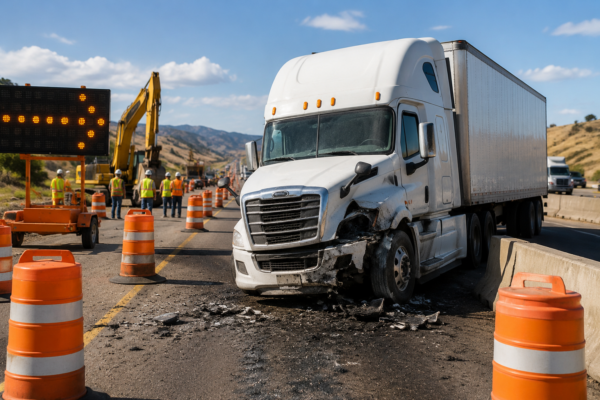
Each summer in Idaho, road crews take advantage of warmer weather to repair highways, expand lanes, and upgrade infrastructure. While these improvements are necessary, they often turn familiar roads into temporary traffic environments that drivers must quickly adapt to. Lanes shift without long-term warning, shoulders disappear, and merge points appear in places where drivers do not expect them.
For passenger vehicles, these changes are inconvenient. For commercial trucks, they can be dangerous. A fully loaded semi requires more space, longer stopping distances, and stable lane conditions to operate safely. When those conditions change suddenly, even skilled drivers can find themselves in situations where reaction time is not enough.
Hepworth Holzer, LLP regularly evaluates injury claims involving highway and work zone crashes throughout Idaho, including Boise and surrounding freight corridors where summer construction is most active.
Why truck accidents increase in construction zones
Construction zones introduce several overlapping hazards that make truck collisions more likely. Traffic is compressed into narrower lanes, which leaves little room for correction when a vehicle drifts or merges unexpectedly. Speed differentials also become more pronounced, especially when some drivers slow significantly while others continue at highway speeds.
Large trucks are particularly affected because their weight and size reduce maneuverability. When traffic slows suddenly or stops due to lane closures, rear-end collisions can occur in seconds. In other situations, trucks attempting to change lanes in tight spaces may sideswipe smaller vehicles or strike temporary barriers.
Uneven pavement, loose gravel, and temporary lane markings also contribute to instability. When combined with congestion, these factors create an environment where minor mistakes can escalate into serious crashes involving multiple vehicles.
For additional background on how truck crashes develop and what legal issues often arise, see:
https://hepworthholzer.com/2020/09/16/idaho-truck-accident-guide/






Driver behavior and decision-making in work zones
Human behavior plays a major role in construction zone collisions. Even when signage is present, some drivers fail to adjust speed appropriately or misjudge the spacing between vehicles. Truck drivers under delivery pressure may feel time constraints that influence driving decisions, while passenger vehicle drivers may underestimate how much space a large truck needs to stop or maneuver safely.
Fatigue is another contributing factor, particularly during long summer driving routes across Idaho highways. Heat, long daylight hours, and increased travel demand can all affect reaction time and focus. When a driver becomes distracted or fatigued in a narrowed construction zone, the margin for error disappears quickly.
Distraction also plays a major role. In congested areas where traffic is constantly shifting, even a brief moment of inattention can lead to a chain-reaction collision involving multiple vehicles.
Road design, signage, and construction planning responsibilities
Not all construction zone crashes are caused solely by driver behavior. Roadway design and construction planning also influence safety outcomes. Poorly placed signage, unclear detour instructions, or abrupt lane reductions can create confusion for drivers entering a work zone.
When truck traffic is not properly accounted for in construction planning, hazards increase significantly. Trucks require earlier warnings for lane shifts and more gradual transitions between traffic patterns. If construction layouts fail to provide that structure, collisions may occur even when drivers are attempting to act cautiously.
In some cases, liability may extend beyond drivers to include contractors or government entities responsible for maintaining safe traffic control measures. These cases require careful investigation into roadway design plans and compliance with safety standards.
Types of truck accidents common in Idaho construction zones
Work zone environments tend to produce specific types of collisions due to the way traffic is controlled and restricted. Rear-end crashes are among the most common, especially when traffic suddenly slows due to lane closures or equipment movement near the roadway.
Sideswipe collisions frequently occur when trucks and passenger vehicles attempt to share narrowed lanes. Even slight lane drift can result in significant vehicle damage and serious injuries due to the size difference between commercial trucks and smaller vehicles.
Rollover accidents can also occur when trucks make abrupt steering adjustments on uneven pavement or when loads shift unexpectedly in response to sudden braking. Multi-vehicle crashes are another risk in congested construction corridors, where one impact can quickly involve several vehicles in close proximity.
Each of these crash types often involves serious injuries due to the force generated by commercial trucks and the limited space available for evasive action.
Liability challenges in construction zone truck collisions
Determining fault in a construction zone crash is rarely straightforward. Multiple parties may share responsibility depending on the circumstances. A truck driver may have acted negligently by speeding or failing to maintain a safe following distance. A trucking company may share liability if it failed to enforce safety policies or maintain vehicles properly.
At the same time, construction contractors may be responsible if lane closures were not clearly marked or if traffic control devices were improperly placed. Government agencies may also be involved if roadway design or maintenance contributed to unsafe conditions.
Rules of a Personal Injury Claim Choosing a Personal Injury AttorneyRelated Videos
Because of these overlapping factors, evidence collection becomes critical. Driver logs, electronic data from trucks, construction zone layouts, and witness statements often play a key role in determining how a crash occurred.
More insight into how investigations are handled can be found here:
https://hepworthholzer.com/2021/02/01/insurance-investigation-for-truck-accidents/
What injured victims should know after a construction zone crash
After a serious collision in a construction zone, the steps taken immediately afterward can affect the outcome of a legal claim. Medical attention should always be the first priority, even if injuries are not immediately obvious. Many crash-related injuries develop or worsen in the hours following an impact.
When possible, documenting the scene can also be valuable. Photos of lane closures, signage, road conditions, and vehicle positions can help establish how the crash occurred. Witness information can also become important during later investigation stages.
Insurance companies often begin evaluating claims quickly, which makes early legal guidance important for preserving evidence and avoiding statements that may affect compensation.
Additional guidance on post-crash steps is available here:
https://hepworthholzer.com/2020/10/19/steps-after-a-truck-accident/
Compensation considerations for injury claims
Victims of truck accidents in construction zones may face significant financial and personal losses. Medical expenses often include emergency care, surgery, rehabilitation, and ongoing treatment. Lost income may also become a major concern when injuries prevent return to work for extended periods.
Non-economic damages may include pain, emotional distress, and reduced quality of life. In more severe cases, long-term disability or permanent impairment can significantly impact future earning capacity.
Because truck accident claims often involve multiple insurance carriers and potentially multiple responsible parties, evaluating compensation requires a detailed understanding of liability and damages.
Preventing construction zone truck crashes
While not all crashes are preventable, certain precautions can reduce risk. Slowing down early when entering construction zones, maintaining increased following distance, and paying close attention to signage can improve safety for all drivers. Truck drivers benefit from extra caution during lane merges and when navigating narrow corridors where clearance is limited.
Construction planners also play a role by ensuring clear signage, gradual lane transitions, and consistent traffic control measures that account for both passenger vehicles and commercial freight traffic.
Legal support for Idaho truck accident victims
When serious injuries occur in construction zone collisions, legal guidance can help clarify responsibility and protect a victim’s rights. Hepworth Holzer, LLP works with injured individuals throughout Idaho to investigate crashes, identify liable parties, and pursue compensation through negotiation or litigation when necessary.
https://hepworthholzer.com/2020/09/16/idaho-truck-accident-guide/
https://hepworthholzer.com/2017/11/02/crashes-involving-semi-trucks-cause-great-damage/
https://hepworthholzer.com/2020/10/19/steps-after-a-truck-accident/
https://hepworthholzer.com/2017/11/12/your-personal-injury-lawsuit/
https://hepworthholzer.com/2022/04/04/what-to-do-when-injured-in-a-truck-accident/
This content is for informational purposes only and is not legal advice. Consult an attorney about your specific situation.

 |
 |