In 2024, 88% of Idaho’s fatal commercial truck crashes happened on rural roads.
Those are the same roads I grew up on, with my grandparents around Mountain Home and Featherville. These are the roads I used to walk outside of Payette near the chicken farm where my mom was raised. These are the roads that we all travel every day. These roads are not built for freight and commercial motor vehicles (CMVs) weighing three or more tons. But Idaho’s draft 2050 Long Range Transportation Plan (LTRP) proposes moving commercial vehicles from interstates to these rural roads.
Between 2016 and 2020, 71% of the people who died in Idaho crashes with CMVs were riding in cars, vans, SUVs, and pickups. In 2020, truck crashes accounted for 20% of Idaho’s traffic deaths. One in five people who died on an Idaho road that year died in a crash with a CMV.
I filed a public comment on Idaho’s draft 2050 Long-Range Transportation Plan (LRTP). The comment is below, in full. The comment period closes September 20, and anyone can file one.






What the plan says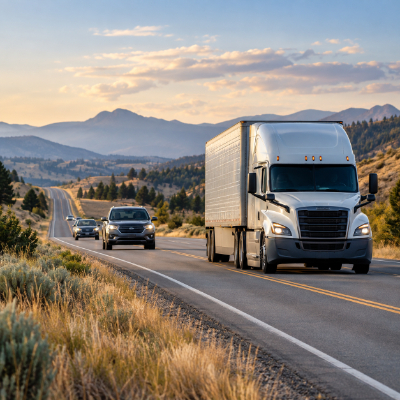
The Idaho Transportation Department (ITD) projects daily truck traffic on Idaho’s highways will grow 64% between 2022 and 2050. On the non-Interstate National Highway System it projects 44%. On the Interstate it projects 14%.
To absorb the increased traffic, the LRTP encourages CMV freight movement on rural roads. It simultaneously acknowledges safety concerns but offers no specific mitigation measures to address them. ITD’s own Strategic Highway Safety Plan names Rural Roads and CMVs as two of its eight emphasis areas. The three strategies under CMVs are enforcement, technology, and education. Not one of them touches the safety aspects.
So the state has a forecast that says more CMVs are coming, a safety plan that outlines that fatal truck crashes happen on rural roads, and nothing that connects the two. ITD is encouraging the movement of more commercial trucks on the roads where the fatal truck crashes already happen at alarming rates.
The rural roads are not suited for CMV traffic
The roads ITD intends to fill with commercial trucks are two-lane state highways. A painted center line. A gravel shoulder, or no shoulder at all. A loaded semi and a family in an SUV pass each other at highway speed with a few feet and a mere strip of paint between them. This is not safe. The LRTP needs to address the safety concerns raised by the increased interaction of CMVs and the motoring public.
What I asked for
Identify the corridors and roads predicted to experience the most CMV traffic increase. Screen them for the countermeasures the state’s own safety plan already lists — rumble strips, wider paved shoulders, better delineation and signing, safety barriers, passing lanes, and geometric work. Add turn lanes and intersection treatment where trucks cross and turn. Track the truck-involved crash rate as a performance measure and report the number every year. Although the Freight Plan proposed that measure in 2023, it did not make it into the current LTRP.
How to comment
The comment period on the draft 2050 LTRP closes September 20, 2026. Comments go through the form at https://www.idaholrtp.com/ . Let ITD know what concerns you.






My comment
I am a trial lawyer in Boise. I represent people hurt and killed in crashes, including crashes with commercial trucks.
ITD projects daily truck traffic on Idaho’s other state highways will grow 64 percent between 2022 and 2050. On the non-Interstate National Highway System it projects 44 percent. On the Interstate it projects 14 percent. 2050 LRTP, Table 7, p. 57. The freight is moving off the freeway and onto two-lane roads.
The draft plan notes that the trend “has significant implications for road wear, safety, and infrastructure investment priorities.” 2050 LRTP, p. 57. Nothing in the plan comes back to it. The safety discussion at page 70 mentions commercial drivers one time, in a list of vulnerable road users. Neither safety strategy mentions trucks at all. 2050 LRTP, p. 95.
The 2026–2030 Strategic Highway Safety Plan names eight emphasis areas. Two of them are Rural Roads and Commercial Motor Vehicles. SHSP, p. 2. In 2024, 74 percent of Idaho’s fatal crashes happened on rural roads. SHSP, p. 29. That same year, 88 percent of fatal commercial truck crashes happened on rural roads. SHSP, p. 37. The Strategic Freight Plan found the same pattern four years earlier. In 2020, 81 percent of fatal truck crashes were rural, and U.S. and state highways accounted for 54 percent of all fatal truck crashes. 2023 Strategic Freight Plan, p. 47.
The forecast and the two emphasis areas describe the same roads. ITD is planning for more heavy trucks on the roads where the fatal truck crashes already happen.
Between 2016 and 2020, 71 percent of the people who died in crashes with commercial trucks were riding in cars, vans, sport utility vehicles, and pickups. 2023 Strategic Freight Plan, p. 47. In 2020 alone, truck crashes accounted for 20 percent of Idaho’s traffic deaths. Id. The draft plan has the direction of the risk backwards. It lists commercial drivers among the people to protect. The people who need protecting are in the other car.
None of the referenced plans owns this problem. The LRTP names the trend and assigns it to no strategy. The SHSP files commercial trucks under Encourage Safe Vehicle Use and gives the emphasis area three strategies — enforcement, technology, and education. SHSP, pp. 36–37. Not one of them touches roadway design. The four Rural Roads strategies never mention trucks. SHSP, p. 29. So, the crash type that killed one in five people on Idaho roads in 2020 has not been identified as a clear growing risk, nor has an actual plan been developed to combat it moving forward.
Analysis of this gap and a plan to remedy it as Idaho grows belongs in this plan. The LRTP is the only one of the three with a horizon long enough to hold it. Name the non-Interstate NHS and state highway corridors carrying the largest projected truck growth. Screen those corridors for the countermeasures the SHSP already lists under Lane Departures — rumble strips, wider paved shoulders, better delineation and signing, safety barriers, passing lanes, and geometric work. SHSP, p. 26. Add turn lanes and intersection treatment where trucks cross and turn. Track truck-involved crash rate as a performance measure. The Freight Plan proposed that measure in 2023 and there is no mention of it in the LRTP. 2023 Strategic Freight Plan, Table 5.1, p. 68. Report the numbers every year.
ITD is planning for more heavy trucks on the roads where the fatal truck crashes already happen. Idaho should decide what it is going to do about that before the trucks get there.