Shorter daylight hours can increase the risk of Idaho pedestrian accidents because trips that took place in full daylight during summer can shift into dusk or darkness during fall and winter. Reduced contrast, glare, shadows, turning vehicles, and limited sight lines can leave drivers with less time to recognize you near an intersection, crosswalk, parking lot, or roadside. Hepworth Holzer, LLP helps injured pedestrians in Boise, Meridian, and communities across Idaho investigate fault, preserve evidence, and address insurance issues after a collision.
The Idaho Transportation Department reports that in 2025, a pedestrian was killed or injured in an Idaho traffic crash about every 32 hours. Sixteen pedestrians were killed during the year. NHTSA reports that 77 percent of pedestrian fatalities nationwide in 2023 occurred in dark conditions.
Idaho Transportation Department, Idaho Traffic Crashes 2025:
https://apps.itd.idaho.gov/Apps/OHS/Crash/25/Analysis.pdf
NHTSA, Pedestrians: 2023 Data:
https://crashstats.nhtsa.dot.gov/Api/Public/ViewPublication/813727






Why Shorter Days Can Change Pedestrian Accident Risk 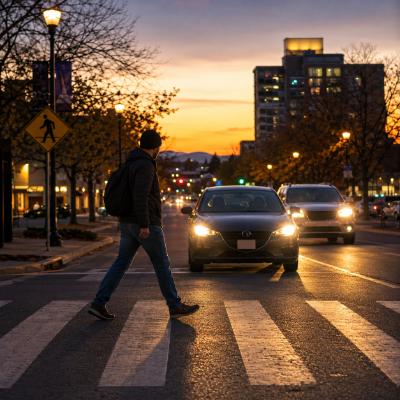
Daylight ends earlier as Idaho moves through fall and winter, while work schedules, school activities, shopping trips, appointments, and evening errands often stay the same. A trip you made at 6:00 p.m. in bright summer conditions may take place after sunset later in the year.
That change can affect what drivers see and how quickly they react. Drivers rely on contrast, movement, roadway lighting, headlights, and clear sight lines to recognize people on foot. During dusk, the sky can remain relatively bright while sidewalks, curb areas, parking lanes, and crosswalk approaches become darker.
If you are walking near parked vehicles, landscaping, buildings, or trees, surrounding shadows can make you harder to distinguish from the background. Headlamp glare and changes in vision during twilight and nighttime can also make pedestrian detection more difficult.
The Federal Highway Administration reports that the nighttime traffic fatality rate is about three times the daytime rate. FHWA explains that nighttime travel accounts for a smaller share of vehicle miles traveled, while reduced visibility can limit the distance available to recognize and respond to roadway hazards.
Federal Highway Administration lighting safety information:
https://highways.fhwa.dot.gov/safety/proven-safety-countermeasures/lighting
Low light can affect visibility, but darkness does not decide fault by itself.






Where Low-Light Pedestrian Collisions Often Happen
Pedestrian crashes can occur anywhere vehicles and people on foot share space. Low-light conditions can make several locations harder to assess.
Common conflict points include:
- Marked and unmarked crosswalks
- Intersections where vehicles turn across pedestrian paths
- Parking lots and garage exits
- School routes and bus stop areas
- Commercial driveways
- Residential streets with curbside parking
- Roads with limited street lighting
For example, a driver making a right turn at a Boise, Idaho, intersection during the evening commute may focus on finding a gap in vehicle traffic and fail to check the crosswalk again before turning. If you are approaching from the driver’s right, you may remain outside the driver’s attention until the vehicle begins crossing your path.
A similar conflict can occur in Meridian, Idaho, when a vehicle exits a shopping center across a sidewalk after sunset.
After either type of crash, the question is not simply whether it was dark. Investigators may examine vehicle speed, driver attention, headlights, traffic signals, sight lines, roadway lighting, pedestrian movement, crossing location, and available reaction time.
What Idaho Crosswalk Rules Mean After a Crash
Idaho law establishes duties for drivers and pedestrians.
Under Idaho Code Section 49-702, when traffic-control signals are not in place or are not operating, a driver must yield the right-of-way, slowing or stopping when necessary, to a pedestrian crossing the highway within a crosswalk. The statute also states that a pedestrian must not suddenly leave a curb or other place of safety and enter the path of a vehicle that is so close that it creates an immediate hazard.
Idaho Code Section 49-702:
https://law.justia.com/codes/idaho/title-49/chapter-7/section-49-702/
These rules can become central after a dusk or nighttime collision. A driver may claim that you could not be seen in time. Evidence involving a marked crossing, working streetlights, vehicle headlights, traffic conditions, witness testimony, and available stopping distance can help show what each person could reasonably have seen and done.
Idaho’s comparative responsibility law can also affect your pedestrian injury claim. Under Idaho Code Section 6-801, damages are reduced in proportion to the injured person’s share of responsibility. Recovery against a particular defendant can be barred when the injured person’s responsibility is as great as that defendant’s responsibility.
Idaho Code Section 6-801:
https://law.justia.com/codes/idaho/title-6/chapter-8/section-6-801/
The firm’s resource on comparative responsibility in Idaho explains how shared fault can affect an injury case:
https://hepworthholzer.com/2020/10/08/comparative-responsibility/
For more information about pedestrian injury cases in Idaho, review:
https://hepworthholzer.com/2019/03/20/idaho-pedestrian-injury-claims/
Why Visibility Evidence Can Matter in a Pedestrian Accident Claim
Lighting conditions can change quickly. A crash scene photographed thirty minutes later may have different light than it had at the moment of impact. An insurance adjuster who visits the location on another day may also see conditions that do not match what you and the driver experienced.
Evidence collected promptly can help reconstruct visibility, movement, and available reaction time.
Useful evidence can include:
- Photographs of the roadway, crosswalk, and surrounding lighting
- The exact collision time and location
- Traffic-camera or business surveillance footage
- Dash camera recordings
- Witness names and contact information
- Vehicle headlight condition and damage
- Police diagrams and measurements
- Phone records when distraction is a disputed issue
- Medical records documenting your injuries
The firm’s guide to evidence in an Idaho pedestrian accident claim discusses records and other proof that can become relevant:
https://hepworthholzer.com/2024/10/17/what-evidence-is-crucial-in-an-idaho-pedestrian-accident-claim/
If your medical condition allows, record what you remember shortly after the collision. Note whether streetlights were operating, whether vehicle headlights were on, where you entered the roadway, which direction traffic was moving, whether the vehicle was turning, and whether parked cars or other objects affected the view.
Rules of a Personal Injury Claim Choosing a Personal Injury AttorneyRelated Videos
How Insurance Issues Can Affect an Injured Pedestrian
Your pedestrian claim may begin with the driver’s bodily injury liability insurance. That policy may not be the only possible source of coverage.
If the responsible driver has no insurance or does not carry enough liability insurance to address your losses, uninsured or underinsured motorist coverage may become relevant. Whether that coverage applies depends on the policy language, the facts of the crash, and whether you qualify as an insured under an applicable policy.
The firm’s uninsured and underinsured motorist resource explains how this coverage can affect Idaho injury claims:
https://hepworthholzer.com/boise-uninsured-and-underinsured-motorist-lawyers/
Insurance adjusters may focus closely on visibility. They may ask what you were wearing, where you crossed, whether vehicle headlights were operating, whether surrounding lighting was adequate, or whether you could have avoided the vehicle.
No single one of those facts decides fault by itself.
Before giving a recorded statement or signing a release, understand what the insurer is requesting and what rights the document may affect. An early settlement offer can arrive before your doctors know the full course of treatment, future limitations, or long-term medical needs.
What Compensation May Be Available After an Idaho Pedestrian Accident?
When another person’s negligence causes your pedestrian injury, available compensation depends on the evidence, your injuries, insurance coverage, allocation of responsibility, and Idaho law.
Recoverable losses may include:
- Emergency medical and hospital expenses
- Follow-up medical treatment
- Rehabilitation and therapy
- Documented future medical needs
- Lost wages
- Reduced future earning capacity
- Pain and physical limitations
- Scarring or disfigurement
- Other documented accident-related losses
A pedestrian injury can affect more than medical bills. A broken leg, head injury, spinal injury, or other serious trauma may keep you from working, require help at home, limit your independence, or require months of rehabilitation.
A properly prepared claim should document both immediate financial losses and the longer-term effects of your injuries.
What to Do After a Low-Light Pedestrian Crash
Seek medical attention first. A vehicle impact can cause head injuries, fractures, neck or back injuries, and internal trauma. Some symptoms may become more noticeable after the initial shock of the collision fades.
Preserve evidence when your medical condition allows. Photograph the area, identify witnesses, and look for nearby homes, businesses, buses, parking facilities, or traffic systems that may have recorded the collision. Keep damaged clothing and personal belongings. Save medical records, wage information, receipts, and insurance correspondence.
Time limits also matter.
Idaho Code Section 5-219 generally provides a two-year limitations period for an action seeking damages for personal injury. Exceptions can apply. Claims involving government entities can also have separate notice requirements. For example, Idaho Code Section 6-906 generally requires claims against a political subdivision or its employee to be presented within 180 days from the date the claim arose or reasonably should have been discovered, whichever is later.
Idaho Code Section 5-219:
https://law.justia.com/codes/idaho/title-5/chapter-2/section-5-219/
Idaho Code Section 6-906:
https://law.justia.com/codes/idaho/title-6/chapter-9/section-6-906/
The firm’s explanation of the statute of limitations for Idaho pedestrian accident lawsuits provides more information:
https://hepworthholzer.com/2024/09/13/the-statute-of-limitations-for-filing-a-pedestrian-accident-lawsuit-in-idaho/
The legal deadline may be measured in months or years, but evidence can disappear much sooner. Surveillance recordings may be overwritten, witnesses can become difficult to locate, vehicles can be repaired, and roadway conditions can change.
Speak With an Idaho Pedestrian Accident Attorney
If you were injured while walking in Boise, Meridian, or another Idaho community, Hepworth Holzer, LLP can review the circumstances of the collision, evaluate visibility and fault evidence, examine available insurance coverage, and explain the legal options that may apply to your situation.
The firm offers consultations at no charge. Call 208-328-6998 or use the firm’s contact page:
https://hepworthholzer.com/contact/
Hepworth Holzer, LLP has offices in Boise and Meridian and represents injured people in communities across Idaho. The website confirms the firm’s current consultation number as 208-328-6998.
This article is for informational purposes only and is not legal advice. Consult an attorney regarding your specific circumstances.