Earlier darkness during Idaho’s fall and winter months can affect your car accident claim by making visibility, headlights, vehicle speed, and driver attention key factors in determining fault. Idaho law requires drivers to use their legally required vehicle lights from sunset to sunrise and whenever visibility falls below specific standards. Darkness does not automatically excuse negligent driving, and you may still recover compensation if you share some responsibility for a collision.
If you suffered injuries in an evening or nighttime accident in Boise, Meridian, or nearby Idaho communities, understanding how reduced visibility affects liability can help you protect your rights. An Idaho car accident attorney can evaluate the evidence, explain comparative negligence rules, and help you pursue compensation for injuries and related losses.






Why Earlier Darkness Matters for Idaho Car Accidents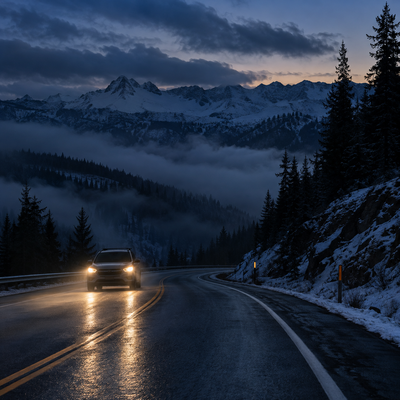
As daylight hours shorten during fall and winter, your regular evening commute may take place after sunset. Roads that were clearly visible during summer evenings may become harder to navigate when natural light disappears.
In Boise, Meridian, and surrounding Idaho communities, changing daylight conditions can make it more difficult to identify pedestrians, recognize roadway hazards, and judge the movements of nearby vehicles.
Earlier darkness can create several driving challenges:
- Reduced visibility: Pedestrians, cyclists, vehicles, and roadway obstacles may be harder to recognize.
- Headlight glare: Oncoming headlights can temporarily interfere with your ability to see.
- Distance perception: Reduced lighting can make it harder to judge how quickly another vehicle is approaching.
- Roadway conditions: Intersections, lane markings, and obstacles may become less visible.
- Evening congestion: Commuter traffic can combine with reduced natural light and increase the attention required of drivers.
When a collision occurs under these conditions, determining fault often requires examining how each driver responded to the available visibility.
Darkness does not automatically establish fault. The key question is whether a driver’s actions contributed to the collision and resulting injuries.






Does Darkness Change Who Is at Fault for an Idaho Car Accident?
Darkness does not automatically change who is responsible for an Idaho car accident. Drivers must continue using reasonable care and adjusting their driving behavior to the conditions they encounter.
In a negligence claim, you generally must establish that another party owed you a duty of care, breached that duty, and caused injuries or losses for which compensation may be available.
A driver may be negligent if that person:
- Travels too quickly for the available visibility.
- Fails to maintain a proper lookout.
- Operates a vehicle without legally required lighting.
- Ignores traffic signals or roadway signs.
- Makes an unsafe turn or lane change.
- Drives while distracted.
For example, suppose you are traveling through a Meridian intersection shortly after sunset. Another driver turns left across your path without yielding.
That driver cannot automatically avoid responsibility by claiming that darkness made your vehicle difficult to see.
An investigation may examine the lighting on both vehicles, their speeds, the traffic signals, the available sightlines, and whether either driver had a reasonable opportunity to prevent the collision.
An Idaho car accident attorney can help you identify the evidence needed to determine responsibility.
Idaho Headlight Laws and Their Impact on Car Accident Claims
Idaho has specific legal requirements governing when drivers must use vehicle lighting.
Under Idaho Code § 49-903, vehicles traveling on highways must display legally required lighting:
- From sunset to sunrise.
- Whenever insufficient natural light makes people or vehicles 500 feet ahead difficult to distinguish clearly.
These requirements mean that headlights and other required lights may be necessary before sunset when visibility becomes limited.
For example, heavy cloud cover, smoke, or other environmental conditions may reduce visibility enough to require vehicle lighting during daylight hours.
If you are involved in a collision during evening twilight, investigators may examine whether the vehicles had their required lights illuminated at the time of the crash.
You can review the applicable statute at:
Can Failure to Use Headlights Establish Negligence?
Failure to use legally required headlights may provide evidence of negligence when inadequate vehicle lighting contributes to an accident.
Consider a collision involving a vehicle traveling without headlights shortly after sunset.
If another motorist could not reasonably identify the approaching vehicle because its required lights were off, that fact may affect the investigation into responsibility.
Relevant questions may include:
- Were the headlights functioning correctly?
- Were the required lights switched on?
- Did the collision occur after sunset?
- Was visibility limited before the collision?
- Would proper lighting have helped another driver recognize the vehicle?
- Did the absence of required lighting contribute to the accident?
A traffic violation may support a negligence claim. Establishing that a driver violated a traffic law does not, by itself, prove every element necessary to recover compensation.
You must still establish the required connection between the negligent conduct, the collision, and your resulting injuries.
Likewise, a driver who uses properly functioning headlights can still be negligent through speeding, distraction, or other unsafe behavior.
Related Videos
Rules of a Personal Injury Claim
Choosing a Personal Injury Attorney
How Reduced Visibility Can Affect Driver Responsibility
Reduced visibility can affect accident liability even when every vehicle involved has working headlights.
Drivers must consider whether their speed, attention, and actions are appropriate for existing roadway conditions.
A posted speed limit does not mean that traveling at that speed is always reasonably safe.
For example, a driver approaching a poorly illuminated intersection in Boise may need additional time to recognize a pedestrian entering a crosswalk.
If that driver fails to maintain a proper lookout or travels too quickly to respond to a reasonably foreseeable hazard, those actions may support a finding of negligence.
Several factors can influence the evaluation of driver responsibility.
- Vehicle speed: Was the driver traveling at a speed appropriate for the visibility and roadway conditions?
- Driver attention: Was the driver watching the roadway or distracted by another activity?
- Vehicle lighting: Were the required lights operating and illuminated?
- Roadway design: Did street lighting, roadway features, or obstructed sightlines contribute to the collision?
- Reaction time: Did the driver have a reasonable opportunity to recognize and respond to a hazard?
- Traffic conditions: Did congestion or nearby vehicle movements affect the driver’s ability to respond safely?
Insurance companies, accident investigators, and attorneys may evaluate these factors when determining whether a driver exercised reasonable care.
Verdicts & Settlements
How Idaho Comparative Negligence Applies to After-Dark Accidents
Idaho follows a modified comparative negligence system under Idaho Code § 6-801.
This law allows an injured person to recover damages in certain cases even when that person shares responsibility for an accident.
Your compensation generally decreases according to your percentage of responsibility.
Under the statute, recovery is barred when your negligence or comparative responsibility is as great as the responsibility of the person against whom you seek recovery. Cases involving multiple parties may require additional legal analysis.
Example of Comparative Negligence in an Idaho Car Accident
Suppose two drivers are involved in a collision shortly after sunset.
One driver makes an unsafe left turn. The approaching driver has failed to illuminate legally required headlights.
After reviewing the evidence, suppose responsibility is assigned as follows:
- Turning driver: 80% responsible.
- Approaching driver: 20% responsible.
- Recoverable damages before the fault reduction: $100,000.
If the approaching driver is the injured claimant, the hypothetical calculation would be:
- $100,000 × 20% = $20,000 reduction.
- $100,000 − $20,000 = $80,000 in potential recovery.
This example is for illustration only and does not represent an actual case result.
The final allocation of responsibility depends on the evidence, the parties involved, and applicable Idaho law.
Insurance companies may argue that an injured driver contributed to a collision by failing to use headlights, traveling too quickly, or failing to maintain a proper lookout.
Understanding Idaho’s comparative negligence system can help you recognize why a careful investigation matters.
You can learn more about comparative responsibility in Idaho at:
The governing statute is available at:
What Evidence Helps Prove Fault in an After-Dark Collision?
Evidence of actual lighting and visibility conditions can be particularly valuable after an evening or nighttime collision.
Because lighting changes around sunset, photographs taken during daylight may not accurately represent the conditions when your accident occurred.
The following evidence may help establish what happened:
- Police reports: These may document the reported collision time, road conditions, driver statements, and other observations.
- Accident photographs: Images may show vehicle damage, intersection design, streetlights, traffic signals, and roadway features.
- Dashcam footage: Vehicle cameras may capture approaching headlights, traffic movements, and the events immediately before impact.
- Surveillance recordings: Nearby businesses or traffic cameras may have footage showing the collision.
- Witness statements: Other motorists, pedestrians, or nearby witnesses may describe vehicle lighting and visibility.
- Vehicle inspections: Examinations may help determine whether headlights were functioning or damaged.
- Electronic vehicle data: Available information may help evaluate speed, braking, and other vehicle movements.
The exact date, time, and location of your collision can also help investigators assess whether sunset or other lighting conditions may have affected the accident.
For example, a photograph of a Boise intersection taken at noon may show the roadway design clearly. It may provide limited information about how well the same intersection could be seen at 6:30 p.m. during late autumn.
In appropriate cases, accident reconstruction professionals may examine the location under comparable lighting conditions.
Preserve photographs, dashcam recordings, and witness information as soon as reasonably possible. Video recordings may be overwritten, and physical conditions can change.
How Insurance Companies Evaluate Darkness-Related Accident Claims
Following an evening or nighttime accident, an insurance adjuster may investigate whether reduced visibility contributed to the collision.
The adjuster may review photographs, police reports, witness statements, medical records, and statements from the involved drivers.
Common questions may include:
- Were both vehicles using the required lights?
- Was the accident after sunset?
- Was either driver distracted?
- Was either vehicle traveling too quickly for the conditions?
- Could either driver reasonably have avoided the collision?
- Did roadway lighting or an obstructed view affect visibility?
The insurance company’s initial assessment does not necessarily establish the final legal determination of fault.
When discussing the accident, provide accurate information and avoid guessing about events you cannot clearly remember.
For example, stating that another vehicle appeared suddenly does not necessarily establish that its driver was speeding.
The evidence may support several possible explanations, including obstructed visibility, distraction, or an inadequate lookout.
An Idaho car accident attorney can help you evaluate the evidence and understand how disputed responsibility may affect your claim.
For additional information about insurance coverage, review:
What Compensation May Be Available After a Darkness-Related Crash?
The amount of daylight at the time of an accident does not independently determine the value of an Idaho personal injury claim.
Compensation depends on the circumstances of the collision, the applicable law, the available evidence, the injuries involved, and the resulting losses.
Depending on your circumstances, recoverable damages may include:
- Medical expenses: Emergency treatment, hospital care, appointments, medication, rehabilitation, and other reasonably necessary medical services.
- Future medical care: Reasonably necessary treatment related to accident injuries that may be required in the future.
- Lost earnings: Income lost because injuries prevented you from working.
- Reduced earning capacity: Financial losses associated with an injury that limits your ability to earn income.
- Property damage: Damage to your vehicle and other qualifying property.
- Physical pain and suffering: Compensation for physical discomfort and other legally recognized noneconomic harm.
- Other qualifying losses: Additional damages recognized under Idaho law when supported by the circumstances.
For example, suppose you are injured in a rear-end collision during an evening commute in Boise.
You may need emergency medical treatment, follow-up appointments, physical rehabilitation, and time away from work.
These losses may become part of your personal injury claim when supported by the evidence and applicable law.
Not every category of compensation applies to every case. Idaho law also places limitations on certain damages, and comparative responsibility may reduce the amount recoverable.
For more information about Idaho injury claims, visit:
What Should You Do After an Idaho Car Accident in the Dark?
The actions you take after a nighttime collision can affect your health, the available evidence, and your potential injury claim.
Consider the following steps.
- Move to safety when possible. If your vehicle creates an immediate hazard and can be moved safely, take appropriate action and request emergency assistance when needed.
- Seek medical evaluation. Obtain appropriate medical care, particularly when you experience pain, dizziness, or other symptoms following the collision.
- Photograph the accident scene. When safe, document vehicle positions, damage, intersections, streetlights, traffic signals, and roadway conditions.
- Exchange required information. Obtain the other driver’s identification and insurance information and collect available witness contact details.
- Preserve electronic evidence. Save dashcam recordings, photographs, messages, and other relevant records.
- Document your injuries and expenses. Maintain medical records, receipts, employment documentation, and other materials showing accident-related losses.
- Notify your insurance company. Follow applicable reporting requirements while providing accurate information about the collision.
- Consider speaking with an Idaho car accident attorney. Legal guidance may help you understand responsibility, evidence preservation, insurance issues, and potential compensation before accepting a final settlement.
Idaho Code § 5-219 generally establishes a two-year filing period for personal injury lawsuits.
Exceptions and different deadlines may apply depending on the circumstances and parties involved. Certain claims, including claims involving government entities, may also involve additional notice requirements.
Prompt legal evaluation can help identify the deadlines applicable to your specific situation.
For further guidance about protecting your interests after a collision, review:
Frequently Asked Questions About Earlier Darkness and Idaho Car Accident Claims
Can Darkness Excuse a Driver Who Causes an Accident?
Darkness alone does not excuse negligent driving. Idaho motorists must exercise reasonable care under existing roadway conditions, including complying with applicable lighting requirements and adjusting their driving behavior when visibility is limited.
Can I Recover Compensation if My Headlights Were Off?
You may still qualify for compensation depending on the circumstances of your accident. If your legally required headlights were off, that fact may affect your share of responsibility. Recovery depends on the evidence, causation, the parties involved, and Idaho’s comparative negligence rules.
Does an Accident After Sunset Automatically Mean Someone Violated Idaho Law?
No. Driving after sunset is lawful. Idaho law requires vehicles to display the applicable lights from sunset to sunrise and when visibility falls below the statutory standard. Whether a violation occurred depends on the relevant facts.
Is a Nighttime Accident Claim Worth Less Than a Daytime Claim?
Not automatically. The time of day does not independently reduce the value of your claim. Potential compensation depends on responsibility, documented injuries, financial losses, insurance coverage, and applicable Idaho law.
Can Poor Street Lighting Affect My Car Accident Claim?
Poor street lighting may be relevant when investigators evaluate visibility, driver behavior, and roadway conditions. Whether a public entity or another party may bear responsibility for a lighting-related condition requires a separate analysis of legal duties, causation, and applicable claim requirements.
How Can I Prove That Another Driver Had No Headlights On?
Witness testimony, dashcam footage, surveillance recordings, photographs, vehicle inspections, and other available evidence may help establish whether another vehicle had its lights illuminated. The usefulness of each type of evidence depends on the circumstances of your accident.
How Long Do I Have to File an Idaho Car Accident Lawsuit?
Idaho generally provides a two-year limitations period for personal injury lawsuits under Idaho Code § 5-219. Exceptions and additional requirements can affect the applicable deadline. An attorney can help determine the filing requirements for your particular claim.
Get Legal Guidance After an Idaho Car Accident
If you suffered injuries in an evening or nighttime car accident, Hepworth Holzer, LLP can help you understand how visibility, headlight use, driver negligence, and Idaho law may affect your claim.
The firm represents injured motorists in Boise, Meridian, and surrounding Idaho communities. Its attorneys can review available evidence, explain your legal options, and help you evaluate potential compensation.
Whether your accident happened during an evening commute, shortly after sunset, or later at night, understanding the facts behind the collision can help you make informed decisions about your next steps.
Contact Hepworth Holzer, LLP online to discuss your Idaho car accident claim.
Office Locations
Boise Office: 537 W. Bannock Street, Suite 200, Boise, Idaho 83702
Meridian Office: 1910 N. Lakes Place, Suite A, Meridian, Idaho 83646
The firm serves clients in Boise, Meridian, and nearby Idaho communities.
Legal Disclaimer
This article provides general information about Idaho car accident claims and does not constitute legal advice. The facts of each collision may affect the applicable legal rules, available compensation, and filing deadlines. Consult a qualified Idaho attorney about your specific circumstances.