

Summary
Liability for a Halloween pedestrian accident in Idaho depends on the conduct of the driver, the pedestrian, and any other person or entity whose actions contributed to the collision. Idaho law generally requires drivers to yield to pedestrians crossing within a crosswalk when traffic-control signals are not in place or operating. Pedestrians also have duties, including not suddenly entering the path of a vehicle that is so close that it creates an immediate hazard.
When more than one person contributes to a collision, Idaho’s comparative responsibility law can divide fault. A pedestrian’s damages can be reduced by the percentage of responsibility assigned to that pedestrian. Recovery against a particular defendant is generally available only when the injured person’s responsibility is not as great as that defendant’s responsibility.
Halloween does not create a separate negligence standard. The circumstances still matter. Drivers should account for conditions they can see, including children and families walking through residential areas, people near intersections and driveways, parked vehicles that limit sight distance, and reduced visibility after dark. Pedestrians should also use reasonable care when entering or crossing a roadway.
Hepworth Holzer, LLP helps injured pedestrians and families evaluate crossing location, driver conduct, visibility, insurance coverage, comparative responsibility, and evidence that may show how a collision occurred.






Why Halloween Pedestrian Accidents Can Raise Difficult Liability Questions
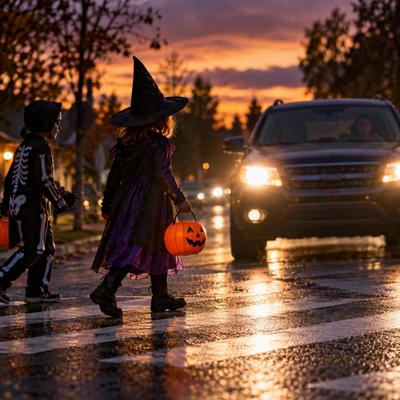
Halloween can place more pedestrians near residential streets, intersections, driveways, and parked vehicles. Children may move between homes, families may cross together, and costumes or masks may affect visibility or peripheral vision. Those facts do not automatically make a driver or pedestrian liable.
The central question is whether a person failed to use the care required under the circumstances and whether that conduct caused or contributed to the injury.
Common liability issues can include:
- Whether the pedestrian was in a marked or unmarked crosswalk
- Whether the driver was turning, backing, or traveling straight
- Whether a traffic signal or pedestrian signal controlled the crossing
- Whether the pedestrian entered the roadway suddenly
- Whether the driver was speeding or distracted
- Whether parked vehicles, landscaping, or other objects affected sight distance
- Whether headlights, streetlights, weather, or surrounding lighting affected visibility
- Whether alcohol or another form of impairment played a role
- Whether the injured pedestrian was a child
- Whether video, vehicle data, witness statements, or physical evidence show what happened
These facts should be considered together. A pedestrian accident claim should not be reduced to a single statement about who had the right of way.






What Idaho Law Says About Pedestrians and Crosswalks
Idaho law gives pedestrians protections in crosswalks while also placing duties on pedestrians who enter or cross a roadway.
Under Idaho Code Section 49-702, when traffic-control signals are not in place or are not operating, a driver must yield the right of way to a pedestrian crossing within a crosswalk. The driver may need to slow down or stop to allow the pedestrian to cross.
The same statute states that a pedestrian may not suddenly leave a curb or another place of safety and walk or run into the path of a vehicle that is so close that it creates an immediate hazard.
A crosswalk does not always need painted lines. Idaho law also recognizes unmarked crosswalks at intersections.
Under Idaho Code Section 49-704, a pedestrian crossing a highway at a point other than a marked crosswalk or an unmarked crosswalk at an intersection must yield the right of way to vehicles on the highway. Between adjacent intersections where traffic-control signals are operating, pedestrians generally must cross within a marked crosswalk.
Drivers still have an independent duty to exercise due care to avoid colliding with pedestrians. Idaho Code Section 49-615 also requires drivers to exercise proper precaution after observing a child or an obviously confused, incapacitated, or intoxicated person.
For more information about pedestrian accident claims, see:
https://hepworthholzer.com/2021/08/30/3-pedestrian-accident-tips/
https://hepworthholzer.com/2022/01/31/6-pedestrian-accident-tips-for-you/
When the Driver May Be Liable
A driver may bear some or all responsibility when careless driving causes or contributes to a Halloween pedestrian collision.
Examples can include a driver who:
- Fails to yield to a pedestrian in a crosswalk
- Travels too fast for the conditions or exceeds the applicable speed limit
- Looks at a phone instead of watching the roadway
- Turns across a crosswalk without checking for pedestrians
- Backs from a driveway without adequately checking behind the vehicle
- Passes a vehicle that has stopped at a marked or unmarked crosswalk to allow a pedestrian to cross
- Drives while impaired
- Fails to take proper precautions after observing children near the roadway
Halloween does not change the basic legal standard. It can change the circumstances a reasonably careful driver should consider. A driver who sees children, families, or heavy pedestrian activity in a neighborhood may need to respond with added attention and caution.
A pedestrian accident investigation may involve photographs, law enforcement reports, witness accounts, vehicle data, nearby cameras, phone records when lawfully obtainable, roadway measurements, medical records, and other evidence.
Can a Pedestrian Be Partly at Fault?
Yes. Idaho uses a comparative responsibility system.
Under Idaho Code Section 6-801, an injured person’s negligence or comparative responsibility does not automatically prevent recovery when that person’s responsibility is not as great as the responsibility of the person from whom recovery is sought. Any damages awarded are reduced in proportion to the injured person’s share of responsibility.
For example, a driver may be traveling too fast through a residential street while a pedestrian crosses outside a crosswalk without checking for traffic. A jury may be asked to determine whether both people contributed to the collision and how responsibility should be divided.
An insurer may argue that a pedestrian wore dark clothing, crossed outside a crosswalk, ignored a signal, or entered traffic unexpectedly. Those allegations should be compared with all available evidence, including:
- The driver’s speed
- The driver’s attention
- Available reaction time
- Sight distance
- Street and vehicle lighting
- Witness statements
- Video evidence
- Vehicle damage and other physical evidence
Hepworth Holzer has additional information about comparative responsibility at:
https://hepworthholzer.com/2020/10/08/comparative-responsibility/
Related Videos
Rules of a Personal Injury Claim
Choosing a Personal Injury Attorney
What If the Injured Pedestrian Is a Child?
Cases involving children require close attention to the surrounding facts.
Idaho Code Section 49-615 requires every driver to exercise due care to avoid colliding with a pedestrian and to exercise proper precaution after observing a child. That rule can be especially relevant on Halloween when drivers can see children walking near streets, driveways, intersections, and parked vehicles.
A Halloween pedestrian accident involving a child may require review of:
- The child’s age and conduct
- The driver’s speed
- The driver’s line of sight
- Whether other children were visible nearby
- The location of parked vehicles
- Whether the driver had enough time and distance to react
- Whether the collision occurred in a crosswalk, driveway, parking area, or roadway
- Statements from adult witnesses
- Video from homes, businesses, vehicles, or doorbell cameras
Responsibility should not be assumed merely because a child entered the roadway. The driver’s conduct and the full circumstances must also be considered.
Could Someone Other Than the Driver Be Liable?
Sometimes. The facts of the collision may support investigation of another person or entity.
Examples can include:
- An employer, when an employee caused the collision while acting within the scope of employment
- A vehicle owner, when a recognized legal basis connects the owner to the collision
- A governmental entity, when a roadway condition or another governmental act or omission may have contributed to the injury
- A manufacturer or other responsible party, when a defective vehicle or component contributed to the collision
Claims involving governmental entities can have special notice rules and deadlines. These cases should be evaluated promptly because ordinary personal injury deadlines may not be the only deadlines that apply.
Key Point:
Do not assume that the person behind the wheel is the only potentially responsible party. Liability depends on the evidence and the legal relationship between each party and the collision.
Verdicts & Settlements
What Evidence Matters After a Halloween Pedestrian Accident?
Evidence can disappear quickly after a neighborhood pedestrian collision.
Halloween decorations come down. Vehicles move. Witnesses leave. Security and doorbell cameras may overwrite recordings. Lighting, parking patterns, and street conditions can change.
If the injured person’s health allows, useful steps can include:
- Call law enforcement and obtain the report or incident number.
- Photograph the roadway, crosswalk, driveway, signs, lighting, parked vehicles, and sight obstructions.
- Identify homes or businesses with exterior cameras.
- Ask that relevant video be preserved before it is overwritten.
- Preserve the costume, shoes, reflective items, or damaged personal property worn during the collision.
- Obtain witness names and contact information.
- Keep medical records, bills, wage information, and insurance correspondence.
- Avoid guessing about speed, distance, or fault when speaking with an insurer.
For broader Idaho injury and car accident information, see:
https://hepworthholzer.com/2020/09/16/idaho-personal-injury-guide/
https://hepworthholzer.com/2020/09/16/idaho-car-accident-guide/
What Compensation May Be Available?
If another party is legally responsible, an Idaho pedestrian injury claim may seek compensation for losses caused by the collision.
Depending on the facts, claimed damages may include:
- Medical expenses
- Future medical care
- Lost income
- Reduced earning capacity
- Pain and physical limitations
- Scarring or disfigurement
- Rehabilitation expenses
- Other documented economic and noneconomic losses
There is no standard settlement amount for a Halloween pedestrian accident. Claim value depends on the liability evidence, injury severity, medical prognosis, available insurance coverage, wage loss, future treatment needs, and the effect of the injuries on the person’s daily life.
Time Limits Can Affect an Idaho Pedestrian Claim
Idaho law generally provides a two-year limitations period for an action seeking damages for personal injury under Idaho Code Section 5-219. The correct deadline can depend on the facts, the identity of the defendant, and the type of claim.
Government-related claims can involve additional and shorter notice requirements. For example, Idaho Code Section 6-906 generally requires a claim against a political subdivision or its employee, for conduct within the scope of employment, to be presented and filed within 180 days from the date the claim arose or reasonably should have been discovered, whichever is later.
Other rules and exceptions can affect a deadline. A person with a potential claim should not assume that the ordinary two-year period is the only time limit that matters.
Prompt action can also protect evidence. Video may be overwritten, physical evidence may disappear, and witnesses may become harder to locate.
Speak With an Idaho Pedestrian Accident Attorney
A Halloween pedestrian collision can leave you managing medical care, insurance communications, missed work, and questions about fault at the same time.
Hepworth Holzer, LLP represents injured people in Boise, Meridian, and nearby communities throughout Idaho. The firm can review the crossing location, driver conduct, available video, witness evidence, insurance coverage, and comparative responsibility issues that may affect your pedestrian injury claim.
You can also contact the firm at:
https://hepworthholzer.com/contact/
This article is for informational purposes only and is not legal advice. Consult an attorney about your specific situation.