If you or your child is hit by a vehicle near a Boise school or crosswalk, the claim can involve Idaho right-of-way rules, driver attention, child safety, insurance coverage, and evidence that may disappear quickly. Idaho law generally requires drivers to yield to pedestrians in crosswalks when traffic-control signals are not in place or are not operating. If you cross outside a marked crosswalk or an unmarked crosswalk at an intersection, you generally must yield to vehicles. Drivers still must exercise due care to avoid colliding with pedestrians.
Idaho Transportation Department data for 2025 show that, statewide, a pedestrian was killed or injured in a traffic crash about every 32 hours. Hepworth Holzer, LLP helps injured people and families evaluate fault, preserve evidence, identify available insurance, and understand the legal steps that may follow a Boise pedestrian accident.
School-year traffic can make these risks more visible. Students walk and bicycle to class, buses stop frequently, pickup and drop-off traffic changes normal driving patterns, and drivers may focus on parking, turning, or traffic queues instead of a person entering a crosswalk. Ada County Highway District has urged drivers in school areas to slow down, stay alert, avoid blocking crosswalks, and watch for students who are walking or biking.





Why School Areas Create Special Pedestrian Risks 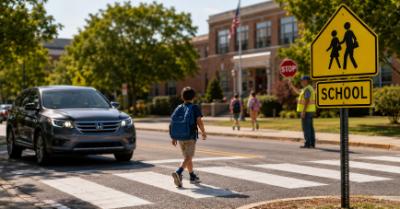
School areas can place children, parents, buses, bicycles, and vehicles in the same limited space during busy morning and afternoon periods. You may be walking with a child, crossing with other students, stepping away from a bus, or moving between parked vehicles while drivers are turning, backing, or trying to get through a pickup line.
Ada County Highway District uses pedestrian crossing treatments in the Boise area that include rectangular rapid flashing beacons, pedestrian hybrid beacons, refuge islands, and leading pedestrian intervals. Some treatments are used near schools. Drivers should expect pedestrian activity even when a crossing does not look like a traditional signalized intersection.
Common school-area pedestrian collision patterns include:
- A turning driver watches vehicle traffic but does not check the crosswalk.
• A driver passes a vehicle that has stopped for a pedestrian.
• A vehicle enters or blocks a crosswalk during a pickup or drop-off queue.
• A child steps from behind a bus, SUV, landscaping, or parked vehicle.
• A distracted driver looks at a phone or navigation screen.
• A backing vehicle strikes a pedestrian in a parking or loading area.
A school location does not automatically determine fault. The conduct of the driver, pedestrian, vehicle owner, employer, school-related party, or public entity may need to be reviewed based on the facts.






What Idaho Crosswalk Law Says
Idaho Code Section 49-702 provides that when traffic-control signals are not in place or are not operating, a driver must yield the right-of-way, slowing or stopping if necessary, to a pedestrian crossing within a crosswalk. The statute also states that a pedestrian must not suddenly leave a curb or other place of safety and enter the path of a vehicle that is too close for the driver to yield safely.
A crosswalk issue is not limited to painted stripes. Idaho law recognizes that an intersection can include an unmarked crosswalk. That point can matter if an insurer argues that you were not entitled to cross where the collision occurred.
Idaho Code Section 49-704 generally requires a pedestrian crossing outside a marked crosswalk or an unmarked crosswalk at an intersection to yield to vehicles on the highway. That rule does not remove a driver’s duty to use care. Idaho Code Section 49-615 requires drivers to exercise due care to avoid colliding with pedestrians.
Signal timing, your position in the roadway, vehicle speed, sight distance, parked vehicles, lighting, crossing devices, and witness accounts can all affect how responsibility is evaluated.
Can You Be Partly at Fault in a Pedestrian Accident?
Yes. Idaho uses comparative responsibility. A pedestrian accident claim can include allegations that both the driver and the injured pedestrian contributed to the collision. Under Idaho Code Section 6-801, damages may be reduced according to your share of responsibility. Recovery against a particular defendant can also be barred when your responsibility is as great as that defendant’s responsibility.
An insurance adjuster may argue that you crossed outside a crosswalk, ignored a signal, entered the roadway suddenly, or were distracted. Those allegations should be compared with the physical evidence, witness accounts, video, traffic controls, and the driver’s conduct.
For more information about Idaho comparative responsibility, visit:
https://hepworthholzer.com/2020/10/08/comparative-responsibility/
Evidence That Can Matter After a School or Crosswalk Crash
Evidence after a school or crosswalk crash can change quickly. Pickup patterns reset the next day, vehicles move, temporary signs disappear, witnesses become harder to locate, and video may be overwritten.
Evidence that may matter includes:
- Police reports and traffic citations
• Photographs of the crosswalk, curb, signs, signals, lighting, and sight obstructions
• School, bus, business, residential, or traffic-camera video
• Dashcam recordings
• Witness names and contact information
• Crossing guard or school incident records
• Vehicle event data
• Phone records when distraction is disputed
• Medical records, bills, and treatment recommendations
• School absence records
• Wage-loss and employment documentation
• Insurance correspondence
Preserve evidence as early as your medical condition allows. Video and witness information can disappear long before a legal deadline expires.
For practical steps after a pedestrian crash, visit:
https://hepworthholzer.com/2024/07/12/what-to-do-immediately-after-a-pedestrian-accident-in-idaho/
Rules of a Personal Injury Claim Choosing a Personal Injury AttorneyRelated Videos
What Compensation May Be Available After a Pedestrian Accident?
If another person or entity is legally responsible for your injuries, a pedestrian accident claim may seek compensation for losses that are supported by the evidence and allowed under Idaho law. Depending on the facts, those losses may include:
- Emergency medical care
• Hospital treatment
• Rehabilitation
• Future medical needs
• Lost income
• Reduced earning capacity
• Pain and physical limitations
• Scarring
• Other documented effects of the injury
If your child is injured, your family may also need to document missed school, activity restrictions, transportation changes, follow-up care, and possible future treatment. The amount and type of compensation depend on the facts, insurance coverage, medical evidence, causation, and allocation of responsibility.
For more information about pedestrian accident case value, visit:
https://hepworthholzer.com/pedestrian-accident-case-value/
Verdicts & Settlements
Insurance Issues After a Boise Pedestrian Accident
The driver’s liability coverage is often the first insurance source reviewed after a Boise pedestrian accident, but it may not be the only potential source. Depending on the policy language and facts, other coverage may be available through a household auto policy, medical payments coverage, uninsured or underinsured motorist coverage, health insurance, or another applicable policy.
Insurance issues can become more involved when the driver was working, making a delivery, driving for a rideshare service, or using a vehicle owned by someone else. Identifying potentially available coverage before you sign a release can protect your ability to evaluate the claim fully.
Be careful with recorded statements. Give accurate information, but do not guess about speed, distance, visibility, or injuries that have not been medically evaluated. An early settlement may not reflect treatment needs that are still developing.
What If a School District or Government Entity May Be Involved?>
A school district, city, highway district, or other public entity is not automatically liable because a pedestrian crash happened near public property. A claim generally requires a legal basis connecting the public entity or its employee to the harm, such as negligent vehicle operation or another actionable condition within the entity’s responsibility.
Government-related claims can have different notice rules. Idaho Code Section 6-906 generally requires a claim against a political subdivision or its employee to be presented within 180 days after the claim arose or reasonably should have been discovered. Idaho Code Section 6-906A contains special timing provisions that can apply to minors.
If your pedestrian accident may involve a school district, city, highway district, or another government entity, do not assume that the ordinary personal injury deadline is the only deadline that matters.
How Long Do You Have to File a Boise Pedestrian Injury Lawsuit?
Idaho Code Section 5-219 generally provides a two-year limitations period for many personal injury actions. Exceptions can change the deadline, and government-related claims can involve earlier notice requirements.
Evidence can disappear much sooner than the filing deadline. Early investigation can help preserve video, locate witnesses, document the crossing layout, and identify the parties responsible for a vehicle, signal, roadway, school transportation service, or other relevant condition.
For more information about Idaho pedestrian accident filing deadlines, visit:
What to Do After a Boise Pedestrian Accident
After a Boise pedestrian accident, focus first on medical care and immediate safety. Call 911 when someone may be injured or when the scene is unsafe. If your condition allows, photograph the area, identify witnesses, collect the driver’s insurance information, and note nearby cameras.
Do not assume that a police report will capture every relevant fact. Write down what you remember about the signal, traffic, vehicle movement, lighting conditions, and where you were located before the collision. Keep medical records, bills, school notes, wage records, and insurance correspondence together.
Avoid detailed social media posts about the accident or your recovery. Before you sign a release, make sure you understand which claims are being resolved and whether your medical condition is sufficiently clear to evaluate the settlement.
Speak With a Boise Pedestrian Accident Attorney
A Boise pedestrian accident near a school or crosswalk can leave you and your family dealing with medical care, missed school or work, insurance calls, and questions about responsibility. Hepworth Holzer, LLP can review the crash, help preserve available evidence, evaluate potential insurance coverage, and explain the legal options that may apply.
Hepworth Holzer, LLP represents injured people in Boise, Meridian, and nearby Idaho communities. To learn more about selecting counsel for a pedestrian injury claim, visit:
https://hepworthholzer.com/choosing-a-pedestrian-accident-attorney/
To request a no-cost consultation, call 208-328-6998 or visit:
https://hepworthholzer.com/contact/
This article is for informational purposes only and is not legal advice. Consult an attorney about your specific situation.